

Short answer
A coverless duvet is a duvet and duvet cover made as one piece: the outer fabric is stitched to the filling, so there is no cover to fit and the whole thing goes in the washing machine. It is worth it if you want to stop changing duvet covers, you have children, students or a spare room to look after, and your bedroom is heated. Ours are warmth class 3, about 7.5 tog, which suits a 16 to 20 degree room; the teddy and velvet version is the one for cooler rooms. The catch is the washing machine: a single washes in a normal 8 to 10 kg drum, but a king needs 10 to 15 kg, which usually means a launderette.
Coverless duvets have gone from a novelty to a category in two years. Searches for them in Ireland have more than doubled since last autumn, every Irish Facebook group has a thread asking whether they are a gimmick, and the honest answer is that they are brilliant for some beds and wrong for others. The difference comes down to three things: how cold your bedroom is, how big your washing machine is, and how much you hate changing a duvet cover.
We stock more than a hundred coverless duvets in microfibre, polycotton, 100% cotton, velvet and teddy fleece, in single, double and king, plus a children’s range, so this guide is written from the product pages rather than from a press release. It explains what a coverless duvet actually is, how warm it is in an Irish house, what it costs against a duvet and cover, which fabric to choose, how to wash one at home, and who should give the idea a miss.
In this article
- What is a coverless duvet, and how is it made?
- Are coverless duvets worth it? The honest pros and cons
- How warm is a coverless duvet, and what tog is it?
- Coverless duvet vs duvet and cover: what it costs
- Microfibre, polycotton, cotton or teddy and velvet: which fabric?
- Which size fits an Irish bed?
- How to wash a coverless duvet at home (and whether it will fit)
- Who should buy one, and who should not
- Frequently asked questions
What is a coverless duvet, and how is it made?
A traditional bed has two items on top: a duvet, which is a casing full of filling, and a duvet cover, which goes over it and comes off to be washed. A coverless duvet collapses those into one. The decorative fabric you see and feel is sewn directly onto the filling, top and underside, and the whole thing is quilted through in diamonds, scallops or channels so the filling cannot migrate. There is no opening, no buttons or press studs, and no inner duvet to line up with the corners. You buy it, shake it out and it is on the bed.
The shape is the same; the difference is that the cover and the filling are one item, which changes what you wash and how often.
Other names for the same thing: all-in-one duvet, coverless comforter, duvet with cover attached, and the brand names some shops use, such as Night Lark. We used to call ours Lazy Duvets, which tells you who they were designed for. On the continent, where most of ours are made, they have been sold for years as a simple way to make a guest bed or a child’s bed in one movement.
Are coverless duvets worth it? The honest pros and cons
The online debate splits into people who have never changed a king size duvet cover alone and people who have. Here is the case for and against, from our own product pages and from two years of customer questions.
| Coverless duvet | Duvet plus duvet cover | |
|---|---|---|
| Changing the bed | Shake out and lay flat; under a minute | Strip, turn, fit, button: 5 to 10 minutes, longer for a king |
| Washing | Whole duvet, every 2 to 3 weeks, 40 degrees | Cover weekly at 40 to 60; duvet two or three times a year |
| Drum size needed | Single 6 to 10 kg; king 10 to 15 kg | Cover fits any machine; duvet needs 7 kg and up |
| Drying | Tumble low, or a day or more on an airer | Cover dries in hours; duvet needs a dryer |
| Warmth choice | One weight, about 7.5 tog; fabric adds or removes a little | Any tog from 4.5 to 15, swapped by season |
| Changing the look | Buy another duvet | Buy another cover from about 15 euro |
| Upfront cost, single | From 29.95 euro, pillowcase included | About 40 euro for a lightweight duvet and a plain microfibre cover set |
| Lifespan | 3 to 5 years with regular washing | Duvet 5 years or more; covers replaced as they fade |
| Weight on the sleeper | Light, 300 gsm filling; easy for older people to lift | Depends on the duvet; a 13.5 tog is heavy |
| Pillowcases | Included, 60 x 70 cm | Included with the cover set |
| Best for | Students, children, guest rooms, carers, anyone who hates the job | Cold rooms, people who want winter and summer weights, people who like to redecorate |
Two of the cons deserve emphasis. First, warmth: a coverless duvet is one weight all year, because the filling is sewn in. Ours are a medium weight that most Irish homes can use for ten months of the year, but it is not a 13.5 tog winter duvet and no amount of marketing makes it one. Second, washing: the whole point is that you wash the entire duvet, so the drum size on the product page is not a suggestion. A king in a 7 kg machine will neither clean nor rinse.
How warm is a coverless duvet, and what tog is it?
Coverless duvets sold in Ireland and the UK range from 4.5 to 10.5 tog, with a few 13.5 tog versions that are too bulky to wash at home. Ours are made in the Netherlands, so they carry a warmth class rather than a tog: every coverless duvet we sell is warmth class 3 with a 300 gsm hollowfibre filling, which converts to about 7.5 tog. Our duvet tog guide for Ireland has the full conversion table; the short version is below.
| Bedroom at night | Typical of | Coverless duvet on its own | What to add |
|---|---|---|---|
| 19 degrees and above | A-rated homes, heating on overnight, summer | Right weight, may be warm in a heatwave | Nothing; sleep under the top layer only on hot nights |
| 16 to 18 degrees | Insulated homes, apartments, heated bedrooms | Comfortable all year | A throw at the foot of the bed in January |
| 13 to 15 degrees | Most pre-2000 Irish houses with the heating off overnight | Fine from April to October; cool in deep winter | Teddy and velvet version, plus a throw or blanket |
| Below 13 degrees | Unheated rooms, single glazing, old farmhouses | Not enough | Use a 13.5 tog duvet with a cover for winter and the coverless duvet for summer |
Fabric moves the felt warmth by about a tog either way. Microfibre and polycotton are neutral. The teddy and velvet version has 200 gsm pile fabric on both faces, and like a teddy fleece duvet cover it makes the same filling feel noticeably warmer on contact, which is why it is the one we point cold sleepers towards. The 100% cotton version breathes best and sleeps coolest, which hot sleepers will prefer. For the fuller comparison of pile fabrics, see our guide to brushed cotton, flannelette and teddy fleece.

200 gsm velvet on top, 200 gsm teddy underneath, 300 gsm filling, warmth class 3. The pile fabrics add about a tog of felt warmth, which makes this the coverless duvet for a cooler Irish bedroom. Beige, black, anthracite, green and two taupes. Designs and sizes shown are subject to availability.
Coverless duvet vs duvet and cover: what it costs
Using our own prices in November 2026, here is what one bed costs to dress both ways. The traditional route uses our lightest duvet (24.95 euro for a single) and our cheapest plain microfibre cover set (14.95 euro for a single), which is the closest match in warmth and fabric.
| Size | Coverless duvet (pillowcases included) | Lightweight duvet + microfibre cover set | Difference |
|---|---|---|---|
| Single | 29.95 euro | 24.95 + 14.95 = 39.90 euro | Coverless saves 9.95 euro |
| Double | 39.95 euro | 34.95 + 19.95 = 54.90 euro | Coverless saves 14.95 euro |
| King | 49.95 euro | 44.95 + 24.95 = 69.90 euro | Coverless saves 19.95 euro |
| Kids single | 34.95 euro | 24.95 + 19.95 = 44.90 euro (kids print cover set) | Coverless saves 9.95 euro |
The honest footnote: a coverless duvet is washed thirty or forty times in the years a traditional duvet is washed three times, so expect to replace it sooner. Over five years the two routes cost about the same. What you are buying is the twenty minutes a week you do not spend on duvet covers, and for a student house, a spare room or a parent with three beds to change, that is the whole argument.

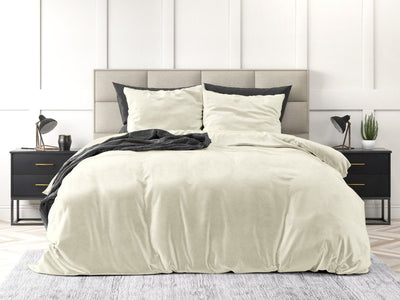
75 gsm microfibre both sides, 300 gsm hollowfibre filling, warmth class 3, matching 60 x 70 cm pillowcases included. Plain Uni colours plus Ruffles, Pintuck, Rafa, Salva and printed designs. Single 140 x 200, double 200 x 200, king 240 x 200 cm. Designs and sizes shown are subject to availability.
Microfibre, polycotton, cotton or teddy and velvet: which fabric?
Every fabric in our range sits over the same 300 gsm hollowfibre filling, so the choice is about feel, breathability, washing and price rather than warmth class.
| Microfibre | Polycotton | 100% cotton | Teddy and velvet | |
|---|---|---|---|---|
| Fabric | 100% polyester, 75 gsm (kids 90 gsm) | 50% cotton, 50% polyester, T128 | 100% cotton, T144 | 200 gsm velvet top, 200 gsm teddy underside |
| Feel | Soft, light, slightly silky | Crisp, closer to a cotton sheet | Cool, crisp, breathable | Plush and warm on both faces |
| Breathability | Moderate | Good | Best | Lowest; traps heat |
| Felt warmth | Neutral | Neutral | Cooler | About one tog warmer |
| Drying time | Fastest | Fast | Slowest | Fast, but heavy when wet |
| Creasing | None | Very little | Some; smooth while warm | None |
| Drum size | About 10 kg (kids 6 kg) | About 10 kg | About 10 kg | 10 kg single, 12.5 kg double, 15 kg king |
| Length | 200 cm | 200 cm | 220 cm | 200 cm |
| Price, single | From 29.95 euro | From 39.95 euro | From 49.95 euro | From 39.95 euro |
| Choose it for | Spare rooms, students, fast turnaround, lowest price | A more natural feel at a mid price | Hot sleepers, sensitive skin, anyone who prefers cotton | Cooler bedrooms, cold sleepers, winter |
If you are unsure, microfibre is the sensible first coverless duvet: cheapest, quickest to dry and available in the most designs. Buy cotton if someone in the bed runs hot or has sensitive skin, and teddy and velvet if the bedroom is one of the cooler rooms in the house. The fabric trade-offs are the same ones that apply to duvet covers, which we cover in the duvet cover materials guide.

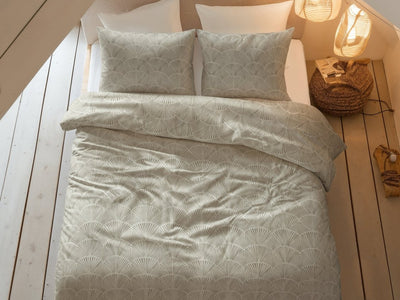
T144 cotton both sides over a 300 gsm hollowfibre filling, so the layer against your skin breathes the way a cotton cover does. Extra-long 220 cm drop in single, double and king. Modern Geo, Feather, Lena, Garden Zen and Gacho prints. Designs and sizes shown are subject to availability.
Which size fits an Irish bed?
Coverless duvets are cut to continental duvet sizes, because that is where they are made. The widths are generous compared with Irish duvet sizes, which is a good thing: a coverless duvet has no cover to tuck, so extra drape at the sides is what keeps it on the bed.
| Our size | Measures | Fits these beds | Compared with the usual Irish duvet |
|---|---|---|---|
| Single | 140 x 200 cm (cotton 140 x 220) | Irish single 90 x 190, EU single 90 x 200, small single | A little wider than a 135 x 200 Irish single duvet |
| Double | 200 x 200 cm (cotton 200 x 220) | Irish double 135 x 190, small double 120 cm, EU 140 and 160 cm beds | Same as a standard 200 x 200 double duvet |
| King | 240 x 200 cm (cotton 240 x 220) | Irish king 150 x 200, EU 180 x 200, and a super king if you accept less drop | Wider than a 225 x 220 Irish king; slightly narrower than a 260 cm super king |
| Kids single | 140 x 200 cm | Any single bed from about age 4 | Standard single width; not for cot beds, which take 120 x 150 |
Pillowcases are included: one with a single, two with a double or king, all 60 x 70 cm, which is the continental pillow size. If you use Irish 50 x 75 cm pillows, keep your existing pillowcases on them or switch to 60 x 70 cm pillows and pillowcases; the duvet does not mind either way. For the full chart of Irish and EU bed, duvet and sheet sizes, see bed sizes in Ireland.
How to wash a coverless duvet at home (and whether it will fit)
This is the section to read before you buy, because the washing machine decides whether a coverless duvet is a time-saver or a weekly trip to the launderette. Every product page in our range lists the drum size the duvet needs; here they are side by side against the machines most Irish homes have.
Most washing machines sold in Ireland are 7, 8 or 9 kg. A kids single at 6 kg is comfortable in any of them. An adult single in microfibre, polycotton or cotton is listed at about 10 kg, and in practice a 9 kg machine will take it if the duvet goes in loose and fills no more than two thirds of the drum. Doubles and kings are a 10 to 12 kg job, and the teddy and velvet king needs 15 kg, which is launderette territory: a 14 to 18 kg machine there costs a few euro and does the duvet properly.
- Check the drum. Loose, with room to move. If you have to force it, it will not rinse, and a duvet that holds detergent goes stiff and smells.
- 40 degrees, normal detergent, no fabric softener. Softener coats hollowfibre and pile fabrics and flattens them. A sensitive-skin detergent is fine.
- Add a rinse and spin high. The filling holds water; an extra rinse clears the detergent and a 1,200 to 1,400 spin halves the drying time.
- Tumble dry on low with two dryer balls or clean tennis balls. They stop the filling clumping. Dry until completely dry, not just dry to the touch, or the inside stays damp.
- No dryer? An airer by a radiator takes 24 to 48 hours in an Irish winter for a double. Turn it twice. This is the strongest argument for owning two.
- How often: every two to three weeks, weekly for children and hot sleepers, straight away after an accident. Always use a fitted sheet underneath, and change the pillowcases weekly as normal.

Embossed 90 gsm microfibre, 300 gsm filling, about 3 cm thick, with one 60 x 70 cm pillowcase. The whole duvet washes in a 6 kg machine at 40 degrees and tumble dries, which is the point when a child is sick at 2 am. Rainbow, dinosaur, astronaut, horses, tractor, giraffe and more, 140 x 200 cm. Designs and sizes shown are subject to availability.
Who should buy one, and who should not
| Situation | Verdict | Why |
|---|---|---|
| Student in rented accommodation | Buy one | One item instead of three, fits a shared machine, back on the bed the same evening, survives the end-of-year move |
| Child from about four up | Buy one, plus a spare | Accidents and bugs mean the whole bed goes in the wash; a kids single fits a 6 kg machine |
| Older person, or anyone with sore shoulders, wrists or back | Buy one | No cover to fight, and at 300 gsm it is lighter to lift than a winter duvet in a cotton cover |
| Carer changing beds for someone else | Buy two | Protector, fitted sheet and duvet come off and go on in one cycle; the second one is on the bed meanwhile |
| Spare room, Airbnb, holiday home or mobile home | Buy one | Guests leave, the bed is washed and remade in an afternoon; no cupboard of covers to manage |
| Hot sleeper | Buy one in cotton | Medium weight and a breathable cotton face suit someone who kicks a 13.5 tog off every night |
| Main bed in a heated home, couple who agree on temperature | Reasonable choice | Medium weight works all year; decide whether you will miss changing the look |
| Cold, unheated bedroom | Do not buy as the winter duvet | Warmth class 3 is not enough below 13 degrees; keep a 13.5 tog with a cover for winter |
| Allergies or asthma | Mixed | Washing the whole duvet every few weeks helps; but ours wash at 40, not 60, so pair with a washable protector and pillow protectors |
| Someone who redecorates with the seasons | Do not buy | Changing the look means another duvet, not a 15 euro cover |
If you are still unsure, buy one coverless duvet for the bed that is changed most often, usually a child’s or a spare bed, and give it a month. Most people either put one on every single bed in the house or go back to covers; very few land in between.
Frequently asked questions
Are coverless duvets a good idea?
For most people who buy one for the right reason, yes. They remove the job of fitting a cover, the whole duvet washes at 40 degrees, and a single costs less than a duvet and cover bought separately. They are a poor idea if you need a 13.5 tog duvet for an unheated room, if your washing machine is under 7 kg and you sleep in a double or king, or if you like to change the look of the bed with the seasons.
Are coverless duvets warm enough in winter?
In a heated Irish bedroom, yes. Ours are warmth class 3 with a 300 gsm filling, which is about 7.5 tog, so they suit a room that stays at 16 degrees or above overnight. For a colder room choose the teddy and velvet version, which adds roughly one tog of felt warmth from the pile fabrics, and put a throw across the foot of the bed. For an unheated room that drops below 13 degrees, a 13.5 tog duvet with a cover is still the better tool.
What tog are coverless duvets?
Most coverless duvets sold in Ireland and the UK are between 4.5 and 10.5 tog, and ours sit in the middle at about 7.5 tog (warmth class 3, 300 gsm filling). That is the all-rounder weight: light enough for summer in most Irish homes, warm enough for autumn, spring and a heated winter bedroom. Very few brands make a 13.5 tog coverless duvet because the extra filling makes it too bulky to wash at home.
Do you use a sheet with a coverless duvet?
Yes, a fitted sheet on the mattress as normal, because the coverless duvet replaces the duvet cover, not the sheet. A flat sheet between you and the duvet is optional: it stretches the time between washes, which is useful for a king size that only fits a launderette machine, but it also brings back one of the layers the coverless duvet was meant to remove.
How often do coverless duvets need washing?
Every two to three weeks in normal use, which is less often than a duvet cover (weekly) but far more often than a traditional duvet (two or three times a year). Wash weekly for children, for anyone who sweats heavily at night, and in summer; wash immediately after any accident. Keep a second one so the bed is never bare while the first is drying.
Can I wash a king size coverless duvet in a washing machine?
At home only if the machine is large enough. Our product pages give the drum size: about 10 kg for a king in microfibre, polycotton or cotton, and 15 kg for the teddy and velvet king. Most washing machines sold in Ireland are 7 to 9 kg, so a king size usually means a 10 or 12 kg machine at home or a 14 to 18 kg launderette machine. Singles fit far more easily, and kids singles need only 6 kg.
Is a coverless duvet cheaper than a duvet and cover?
Upfront, yes. Our microfibre coverless single is 29.95 euro with a pillowcase included, against about 40 euro for a lightweight single duvet and a plain microfibre cover set bought separately, and the gap widens to about 20 euro on a king. Over time it evens out, because the whole duvet is washed every few weeks and will need replacing after three to five years, whereas a duvet kept inside a cover can last longer. The saving is in time rather than money.
Where to go next
Microfibre for most beds, cotton for hot sleepers, teddy and velvet for cooler rooms, and a kids single for anyone under ten. Check the drum size before you check out.
Prices and availability shown are correct at the time of writing and change with stock. Drum sizes are taken from each product page; if your machine is close to the limit, the product page is the figure to trust.


