

Short answer
A mattress protector is a thin fitted sheet that sits under your bottom sheet and takes the sweat, spills and dust that would otherwise go into the mattress. Buy a waterproof one (cotton top, breathable TPU membrane) for children, guest beds, allergies, pets or anyone who has accidents; buy a plain cotton molton one for an adult bed that just needs protecting from sweat and wear. Order it by mattress size (an Irish king takes a 160 cm protector, an Irish double takes 140 cm) and by mattress depth: 30 or 40 cm corners for a mattress, 10 or 15 cm corners for a topper. Wash a waterproof protector at up to 95 degrees and dry it on low.
Nobody gets excited about a mattress protector, which is why most Irish beds either do not have one or have the wrong one: a quilted pad that soaks through, a plastic sheet that sweats, or a protector with 20 cm corners on a 30 cm mattress. The mattress underneath cost 500 to 2,000 euro and cannot be washed. The protector costs 15 to 40 euro and goes in the machine. That is the whole argument, and the rest of this guide is about picking the right one.
We sell five fitted protectors, all made in the Netherlands by Dreamhouse, in two constructions: a waterproof one with a 100% cotton top over a breathable TPU membrane, and a cotton molton one that absorbs moisture but is not waterproof. Between them they cover single narrow to super king, toppers, and split-top beds, with corner depths from 10 to 40 cm. This guide explains which construction to choose, which size to order for an Irish bed, which corner depth you need, and how to wash it so it keeps working.
In this article
- Is it worth using a mattress protector?
- Which type of mattress protector is best: waterproof, molton, quilted or plastic?
- Do waterproof mattress protectors actually work?
- What size mattress protector do I need for an Irish bed?
- Which corner depth: 10, 15, 30 or 40 cm?
- Mattress toppers and adjustable beds: topper and split-top protectors
- How to wash a mattress protector
- Which protector for which bed
- Frequently asked questions
Is it worth using a mattress protector?
Yes, and the reasons are more practical than the marketing suggests. An adult loses up to half a litre of moisture a night through sweat and breath. The fitted sheet catches some of it and gets washed weekly; the rest goes into the mattress, where it feeds dust mites and leaves the yellow marks that appear on an unprotected mattress within a year or two. A mattress cannot be washed, most manufacturers will not honour a warranty claim on a stained one, and a good mattress is expected to last eight to ten years. A protector is the washable layer that lets it.
| What goes into an unprotected mattress | What the protector does | Molton | Waterproof |
|---|---|---|---|
| Sweat and night-time moisture | Absorbs it and is washed out | Yes | Yes, and it cannot reach the mattress |
| Spilled tea, coffee, baby bottles | Stops the spill at the surface | Slows it only | Yes |
| Children’s accidents | Keeps the mattress dry | No | Yes |
| Dust mites and skin cells | Washable at high temperature, which a mattress is not | Yes | Yes, at 95 degrees |
| Pets on the bed | Hair and paws stay on the washable layer | Yes | Yes |
| Staining that voids the warranty | Mattress stays as it came | Mostly | Yes |
The other thing a protector does is make the bed easier to run. A protector plus fitted sheet comes off and goes on in one movement, which is why carers, parents and anyone running a spare room or an Airbnb put one on every bed. If that describes you, our coverless duvets guide covers the top half of the same idea.
Which type of mattress protector is best: waterproof, molton, quilted or plastic?
There are five kinds sold in Ireland, and two of them are worth buying.
| Type | What it is | Good for | Watch out for | In our range |
|---|---|---|---|---|
| Waterproof (cotton + TPU) | Cotton terry or molton bonded to a thin, breathable polyurethane film | Children, guest beds, allergies, pets, accidents, new mattresses | Tumble drying hot damages the membrane | Yes: fitted, split-top and topper versions |
| Cotton molton | A single brushed cotton-rich layer that absorbs moisture; also sold as a mattress cover or under-blanket | Adult beds, hot sleepers, anyone who wants the coolest option | Not a barrier: a spill will reach the mattress | Yes: fitted, split-top and topper versions |
| Quilted or padded | Polyester wadding quilted between two thin fabrics | Softening a hard mattress slightly | Soaks through, slow to dry, elastic skirts give up early | No |
| Plastic, PVC or vinyl | A solid waterproof sheet, often with a thin fabric face | Nothing a TPU protector does not do better | Sweaty, noisy, smells, cracks within a year | No |
| Zipped encasement | Six-sided bag that encloses the whole mattress | Bed bugs, severe dust-mite allergy | Hard to fit and wash; most people need a fitted protector instead | No |
Both of our constructions are fitted sheets with elasticated corners, so they go on like a bottom sheet and stay put.
The honest summary: if any liquid is ever likely to land on the bed, buy the waterproof one. If the bed belongs to an adult who simply wants to keep the mattress clean and sleep as cool as possible, buy the molton one and save a few euro. Both are anti-allergy and anti dust mite, both are white because nobody ever sees them, and both wash in a normal household machine.

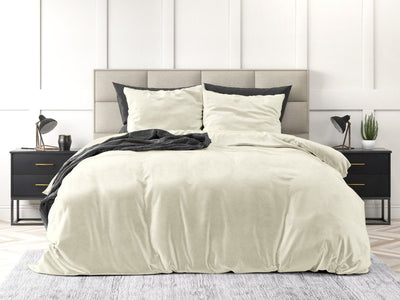
160 gsm cotton top over a breathable 170 gsm TPU membrane, anti-allergy and anti dust mite. Corners 30 cm deep on single sizes and 40 cm on double, king and super king. Single narrow 80 x 200 to super king 200 x 220 cm. Designs and sizes shown are subject to availability.
Do waterproof mattress protectors actually work?
A properly made one works completely, and the reason some people doubt it is that the shops are full of ones that are not properly made. Three things decide whether a waterproof protector keeps a mattress dry:
- Waterproof, not water-resistant. Water-resistant means the fabric has a coating that slows a spill for a minute. Waterproof means there is a continuous membrane that liquid cannot cross. Ours use a 170 gsm TPU (thermoplastic polyurethane) film laminated to the cotton, the same family of membrane used in outdoor jackets. It passes water vapour, so you do not sweat on it, and it blocks liquid.
- Corner depth. The membrane only covers what it touches. A protector whose corners are shallower than the mattress leaves the sides exposed, and a large accident runs down the side. Match the corner depth to the mattress; the chart below shows how.
- Care. Heat is the enemy of the membrane. Ours are rated for a 95 degree wash, which is hotter than most, but drying should be on a line or a low tumble. A hot tumble dry or an iron will crack any TPU film and it will leak from then on.
The disadvantages people report are mostly about the cheap plastic kind: heat, rustling and a chemical smell. A cotton-topped TPU protector sleeps very slightly warmer than plain molton, because the membrane slows airflow a little, but it is nothing like the sweatiness of a PVC sheet. If you run hot and do not need the waterproofing, molton is the cooler choice.
What size mattress protector do I need for an Irish bed?
Our protectors are made in continental sizes, so the width on the label is a few centimetres wider than the Irish mattress it fits. That is fine for a fitted sheet, because the elasticated corners pull the extra width under the mattress. Measure the mattress (not the bed frame) and use this table.
| Irish bed | Mattress size | Order this size | Waterproof fitted | Molton fitted |
|---|---|---|---|---|
| Cot bed | 60 x 120 cm | Cot Bed 60 x 120, 10 cm corners | Listed; not in stock right now | Not made |
| Toddler bed | 70 x 140 cm | Toddler Bed 70 x 140, 15 cm corners | Listed; not in stock right now | Not made |
| Small single or EU single | 80 x 200 cm | Single Narrow (EU) 80 x 200, 30 cm | From 20.95 euro | Single Narrow 70 x 200, not in stock right now |
| Single | 90 x 190 or 90 x 200 cm | Single 90 x 200 or 90 x 220, 30 cm | From 22.95 euro | Single 90/100 x 220, 14.95 euro |
| Large single | 100 x 200 cm | Large Single (EU) 100 x 200, 30 cm | 23.95 euro | Single 90/100 x 220, 14.95 euro |
| Small double | 120 x 190 cm | Small Double (EU) 120 x 200, 30 cm | 26.95 euro | Double 140 x 200, not in stock right now |
| Double | 135 x 190 cm | Double 140 x 200, 40 cm | 28.95 euro | Double 140 x 200, not in stock right now |
| King | 150 x 200 cm | King 160 x 200 or 160 x 220, 40 cm | From 31.95 euro | King 160 x 200/220, 23.95 euro |
| Super king | 180 x 200 cm | Super King 180 x 200 or 180 x 220, 40 cm | From 35.95 euro | Super King 180 x 200/220, 25.95 euro |
| Emperor or 200 cm wide EU bed | 200 x 200 cm | Super King 200 x 220, 40 cm | 40.95 euro | Super King 190/200 x 220/230, not in stock right now |
Two notes. A 190 cm long Irish mattress takes a 200 cm protector without any trouble, and the 220 cm lengths are for the longer continental beds that are becoming common in Irish bed shops. If you are not sure which bed you have, our bed sizes in Ireland chart has every mattress, duvet and sheet size side by side.

Brushed molton in 80% cotton and 20% polyester at 160 gsm. It absorbs sweat and keeps the mattress clean without a waterproof layer, so it sleeps cool. 30 cm corners; single 90 x 220, king 160 and super king 180 x 200 or 220 cm. Designs and sizes shown are subject to availability.
Which corner depth: 10, 15, 30 or 40 cm?
This is the measurement everyone skips and the one that causes most returns. The corner depth printed on a fitted protector is the height of the elasticated skirt, and it has to be at least as deep as the mattress, or the protector will not reach under the mattress and will ping off at the first turn. Measure from the top surface of the mattress to its bottom edge; if you sleep on a topper, measure the topper on its own for the topper protector, and the mattress on its own for anything that goes beneath it.
Deeper is fine, shallower is not. A 40 cm corner on a 24 cm mattress simply tucks further underneath, so when in doubt go deeper. The one exception is a topper, where a deep corner has nothing to grip and slides about, which is why topper protectors are cut at 10 or 15 cm. For the fitted sheet that goes on top of all this, the same rule applies; our deep fitted sheets have 30 cm corners and the extra deep fitted sheets go to 40 cm; the fitted sheet guide has the full depth chart.
Mattress toppers and adjustable beds: topper and split-top protectors
A topper is the surface you actually sleep on, so it is the surface that needs protecting. The protector goes over the topper and under the fitted sheet, and it should be a topper protector with 10 or 15 cm corners so the elastic grips the topper rather than the mattress two layers down. If you want the mattress protected as well, a molton protector between topper and mattress does it; that layer never sees liquid, so it does not need to be waterproof.
Adjustable beds and continental boxsprings with a split topper need a split-top protector: the same fitted sheet with a slit down the centre of the top third, so the two halves of the bed can be raised separately without the protector tearing or pulling the topper across. Our waterproof split-top has 10 cm corners for the split topper and comes in double, king and super king; the polycotton molton split-top has 15 cm corners in king.
| Your bed | On top of the topper | Between topper and mattress | Corner depth to order |
|---|---|---|---|
| Mattress only | Waterproof or molton fitted protector | Nothing | 30 cm (singles) or 40 cm (double and up) to match the mattress |
| Mattress with a 4 to 8 cm topper | Topper protector, 10 cm corners | Optional molton protector | 10 cm on the topper; 30 or 40 cm underneath |
| Mattress with a thick 8 to 12 cm topper | Topper protector, 10 or 15 cm corners | Optional molton protector | 15 cm on the topper |
| Adjustable or boxspring bed with a split topper | Split-top protector, 10 cm (waterproof) or 15 cm (polycotton) | Optional molton protector | 10 or 15 cm, split-top |
| Cot bed or toddler bed | Waterproof fitted protector, 10 or 15 cm corners | Nothing | Cot bed 10 cm, toddler bed 15 cm |

The same cotton and TPU construction with a slit in the top third, so each half of an adjustable bed or split topper moves on its own. 10 cm corners for split toppers; a 15 cm polycotton molton version is also available. Double, king and super king. Designs and sizes shown are subject to availability.

Shallow 10 cm corners (waterproof cotton and TPU) or 15 cm corners (polycotton molton) that grip a topper instead of sliding off it. Super king 200 x 200 and 200 x 220 in waterproof, king 160 in polycotton. Designs and sizes shown are subject to availability.
How to wash a mattress protector
A protector only protects while it is clean, and the whole point of the waterproof one is that it can be washed hotter than anything else on the bed.
| Waterproof (cotton and TPU) | Molton (cotton and polyester) | |
|---|---|---|
| How often | Every 1 to 2 months; straight away after a spill or accident; weekly for a child with accidents | Every 1 to 2 months, or with the sheets if the bed is used heavily |
| Temperature | Up to 95 degrees; 60 degrees is enough for dust mites and most stains | The temperature on the care label |
| Detergent | Normal detergent; no bleach, no fabric softener (softener coats the membrane) | Normal detergent; no softener, it reduces absorbency |
| Load | On its own or with towels; do not overload, the membrane needs to move | With the sheets is fine |
| Drying | Line dry, or tumble on low with the cotton side out; never hot, never iron | Line or tumble on medium |
| Lifespan | 3 to 5 years if never tumbled hot | 5 years or more |
| Signs it is finished | Membrane crazes or peels, water beads then soaks | Thin patches, elastic gone |
Which protector for which bed
| Bed | Buy | Why |
|---|---|---|
| Child from toddler bed to single | Waterproof fitted, 30 cm, and a second one | Accidents, bugs and spilled drinks; washes at 95 degrees between uses |
| Teenager | Waterproof fitted | Sweat, drinks in bed, the mattress has to last through college |
| Main adult bed, no issues | Molton fitted | Coolest option; keeps the mattress clean and the warranty intact |
| Hot sleeper | Molton fitted | No membrane, so nothing slows airflow |
| Allergies or asthma in the house | Waterproof fitted | Dust mites cannot get into the mattress and the protector washes at 95 degrees |
| Guest room, Airbnb, student let | Waterproof fitted | Whatever a guest does, the mattress survives it |
| Older person or someone being cared for | Waterproof fitted, two of them | Quick changes, high-temperature washes, no plastic feel |
| Pets on the bed | Waterproof fitted | Hair, paws and the occasional accident stay on the washable layer |
| New mattress with a warranty | Either, fitted on day one | A stained mattress is usually outside the warranty |
| Topper on the bed | Topper protector, 10 or 15 cm | The topper is the surface that takes the wear |
| Adjustable or boxspring bed | Split-top protector | The two halves move independently |
The last question people ask is whether to buy the protector in the same order as the sheets. Yes, if the bed is new or the mattress has never had one: fit the protector first, then the fitted sheet over it, and the fitted sheet can have the same corner depth or deeper. Which sheet size an Irish bed takes and how deep its corners should be is covered in our fitted sheet sizes and corner depth guide.
Frequently asked questions
Is it worth using a mattress protector?
Yes. A mattress absorbs sweat every night, cannot be washed, and most makers will not honour a warranty on a stained one. A fitted protector costs from 14.95 euro, washes in the machine and takes all of that instead of the mattress. For a child, a guest bed, a rented room or anyone with allergies it is the first thing to put on a new mattress.
Do waterproof mattress protectors actually work?
A proper one does. Ours have a 100% cotton top over a TPU membrane that liquid cannot pass through, which is different from a water-resistant finish that only slows a spill down. The membrane is breathable, so it does not feel like sleeping on a bin bag. Two things undo a waterproof protector: tumble drying it hot, which cracks the membrane, and a corner depth that leaves the mattress sides exposed.
What are the disadvantages of a waterproof mattress protector?
Cheaper PVC or vinyl ones trap heat, rustle when you turn over and smell of plastic; a TPU-backed cotton one avoids all three. Any waterproof protector sleeps very slightly warmer than a plain cotton molton one, because the membrane slows airflow a little. It needs washing on its own at a high temperature, and it should be dried on low or on the line. For a hot sleeper who does not need the waterproofing, the molton version is cooler.
Which is better, a mattress pad or a mattress protector?
They do different jobs. A mattress pad or quilted topper adds padding and comfort; a mattress protector is a thin barrier that keeps sweat, spills and dust mites out of the mattress. If you want both, use a topper for comfort and a fitted topper protector with 10 or 15 cm corners over it. A thick quilted protector that promises comfort usually does neither job well.
Should you put a mattress protector over a mattress topper?
Yes, the protector goes on top of the topper, directly under the fitted sheet, because the topper is the surface that takes the sweat and spills. Use a topper protector with 10 or 15 cm corners so it grips the topper rather than sliding off. If you also want the mattress underneath protected, add a plain molton protector between topper and mattress.
Do mattress protectors protect from pee?
A waterproof one does, provided the corner depth matches the mattress so the liquid cannot run down the side. For a child who is potty training or has night-time accidents, buy two waterproof protectors so one is on the bed while the other is in the wash, and wash at 95 degrees, which our cotton and TPU protectors are rated for. A molton protector absorbs a small amount but is not a barrier.
How often should you wash a mattress protector?
Every one to two months in normal use, straight away after a spill or accident, and weekly for a bed with a child who has accidents. Wash a waterproof protector at up to 95 degrees on its own, with no fabric softener and no bleach, then line dry or tumble on low with the cotton side out. Wash the molton version at the temperature on its care label.
What size mattress protector do I need for a king size bed in Ireland?
An Irish king mattress is 150 x 200 cm, so order our King 160 x 200 cm size; the fitted corners pull the extra 10 cm under the mattress. Irish super king (180 x 200 cm) takes the Super King 180 x 200 size; Irish double (135 x 190) takes Double 140 x 200; Irish single (90 x 190) takes Single 90 x 200 or 90 x 220. Measure the mattress depth as well, because the corner has to be at least that deep.
Where to go next
Waterproof for children, guests, allergies and pets; molton for a cool adult bed; topper and split-top versions for the beds that need them. Measure the mattress depth before you order.
Prices and availability shown are correct at the time of writing and change with stock. Corner depths and wash temperatures are taken from each product page; if a size is close to the limit, the product page is the figure to trust.


